


Driejarige brugklas - Middle Years Curriculum

DENISE's secondary education programme starts in Year 9, building on the learning and development achieved in Year 8. Up to and including Year 11 (the lower years of secondary education), students of different academic abilities learn together in mixed-ability classes and follow the IMYC – International Middle Years Curriculum.
After Group 11 (the third year of secondary education), students can choose whether to complete their VMBO-TL (MAVO) diploma at DENISE or continue through Group 12 before progressing to the International Baccalaureate (IB) Diploma Programme, an English-language programme at Dutch HAVO/VWO level.
If a Dutch-language HAVO or VWO programme is a better fit for your future plans, you can also continue your education at a mainstream Dutch secondary school.
Our Middle Years Curriculum is designed for students aged 12 to 15. It focuses on maintaining students' engagement and enthusiasm for learning, while responding to the specific needs of the developing adolescent brain. The IMYC is used in both independent and state-funded schools around the world.
Information about registration for Year 9
For the admission of students moving from Year 8 to secondary education, DENISE participates in the City of Amsterdam's central school placement policy. Students currently in Year 8 can register to take part in the Central Lottery and Matching System. Their current primary school can provide further information.
For additional information about the central lottery system, please visit https://schoolkeuze020.nl/. You can also find information about the transition to secondary education on this website.
At DENISE, we primarily focus on providing education for students aged 4 to 18 who are new to the Netherlands or have an international (educational) background. We therefore have certain requirements regarding students' proficiency in both English and Dutch.
Our information booklet provides an overview of DENISE and the IMYC programme.
You can register for one of our information sessions via the Registration page.

IMYC en het "Big Idea"
Learning Through Big Ideas
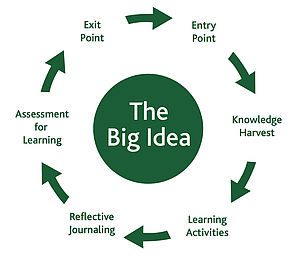
In both primary education and the lower years of secondary education, each year group focuses on five thematic units based on Big Ideas. All subjects are connected to and taught through a central overarching question or concept. Learning takes place through a seven-step learning cycle. This approach supports the development of essential subject knowledge and skills that students need to participate in society, build their general knowledge, make a successful transition to secondary education and, ultimately, prepare for a diploma programme. Students develop a solid foundation of knowledge and acquire the skills they need to carry out research, give presentations and use a range of media to communicate and showcase their learning. Personal development is also an important part of the programme. It is integrated into all lessons and receives particular attention during the daily mentor sessions. Each unit concludes with an Exit Point. During this activity, students are invited to demonstrate their understanding of what they have learned and reflect on what it means to them personally and how it relates to the real world. Planning and producing the Exit Point gives students the opportunity to share their learning outcomes creatively with fellow students, parents and teachers, while also reflecting on their own progress and achievements. Learning with and from one another is an essential part of education at DENISE.
We have prepared a presentation that provides an overview of the IMYC and the concept of Big Ideas.
Choosing a Pathway and Specialisation Later in Education
Over the past few years, DENISE has developed a bilingual, mixed-ability primary and secondary education programme based on the International Primary Curriculum (IPC) and the International Middle Years Curriculum (IMYC). This approach does not involve early academic selection. After Year 8, students normally continue into Years 9, 10 and 11 within our secondary education programme. The only exception is when we are convinced that a student will not be able to meet the requirements of the VMBO-TL level. This is identified as early as Years 6 or 7, allowing parents sufficient time to consider and choose another school.
In the lower years of our secondary education (Years 1, 2 and 3), students are taught together in mixed-ability classes. These students have the potential to progress to a VMBO-TL, HAVO or VWO diploma programme. Differentiation is an essential part of the learning process, allowing each student to develop at their own level and pace. Our teachers dedicate time and attention to meeting these individual learning needs.
In Group 11, students go through the admission process for one of the diploma programmes. Depending on their abilities and ambitions, they can then choose between Dutch- or English-language education. We believe this is the most inclusive educational approach for this particular target group and that it helps reduce educational inequality and unequal opportunities.